Reconstructing Christchurch

A Seismic Shift in Building Structural Systems

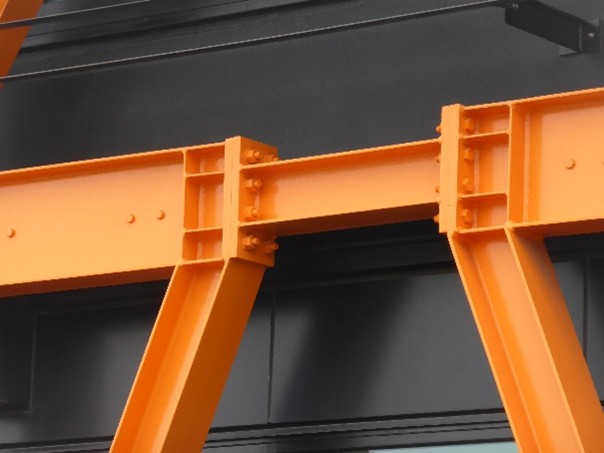
Eccentrically braced frame — vivid orange steel structure
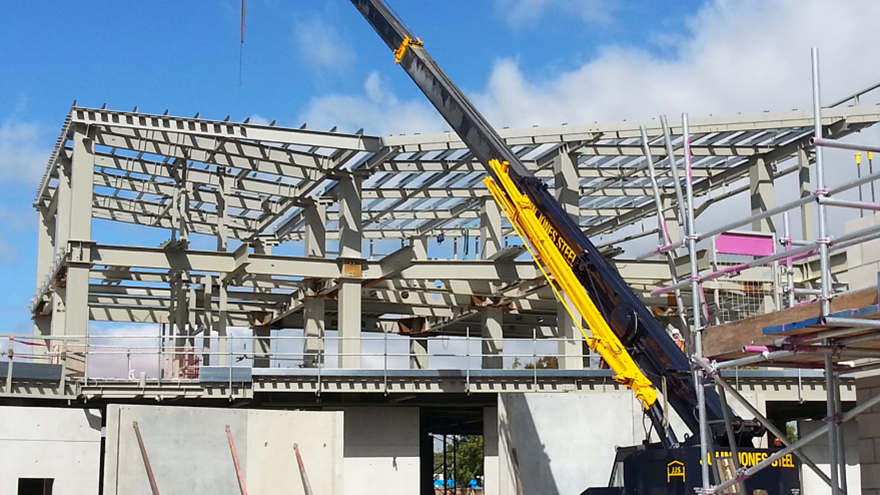
Steel frame under construction with crane, Christchurch rebuild
Completed multi-storey steel frame, Christchurch CBD

About the Report

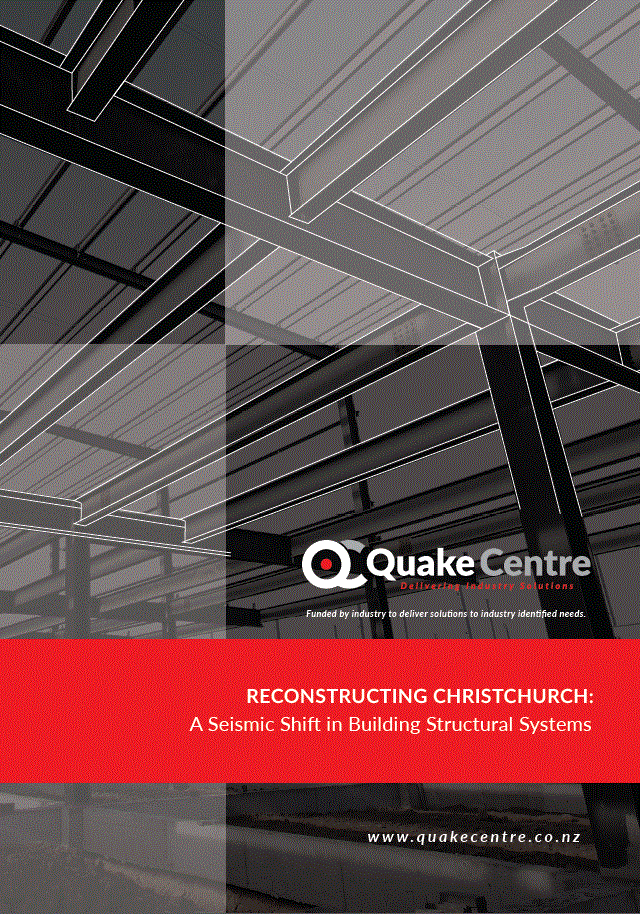
Reconstructing Christchurch — English edition cover
Michel Bruneau & Greg MacRae
Reconstructing Christchurch
A Seismic Shift in Building Structural Systems
Quake Centre, University of Canterbury — 2017
Free Download (PDF)
Multi-storey steel frame under construction in Christchurch CBD
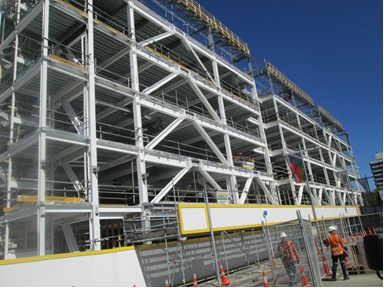
New steel-framed construction in Christchurch's CBD — a stark contrast to the pre-earthquake concrete landscape.

After the 2010–2011 Canterbury earthquakes, much of the Christchurch Central Business District (CBD) was demolished, and a new city has emerged in its place. From a structural engineering perspective, to date, the new "heart" of Christchurch is quite different from the old one. Where reinforced concrete buildings dominated the urban landscape, with almost all multistory buildings relying on RC frames or walls to resist earthquake shaking, the emerging Christchurch has a variety of structural forms, an extensive amount of steel structures, and a number of structural systems introduced to make the new buildings of Christchurch more seismically resilient.

This report describes a study conducted to (a) quantify the extent to which various types of structural system have been used in the new buildings constructed by early 2017, and (b) identify some of the drivers that have influenced decisions about the selection of structural material and specific structural systems used. The study involved a series of interviews with the structural designers of more than 60% of the post-earthquake buildings constructed to date in Christchurch's CBD (i.e., 74 buildings), as well as with engineers from Wellington and Auckland, an architect, a project manager, and a developer. Data was also collected from various sources (including Christchurch's City Council database), and quantitative information on structural forms and decision drivers has been assembled for the 74 buildings considered.

This report is useful in providing insights into some of the mechanisms that can dictate structural engineering decisions during the post-earthquake reconstruction of a modern city.

The Christchurch experience may be unique today, but it could repeat itself in other similarly developed cities worldwide after future devastating earthquakes.

And each time history repeats itself, the price goes up.

Could your town be the Christchurch of tomorrow? Download Free Report

Media Coverage

2016 Interviews on Project Objectives (prior to study)

Chinese Translation
Chinese translation cover
Sincere thanks to Professor Wei Wang, Professor of Structural Engineering and Deputy Head of Department of Structural Engineering at Tongji University, for publishing the Chinese Translation of the Report "Reconstructing Christchurch: A Seismic Shift in Building Structural Systems". For those who can read Chinese, the report can be obtained from: https://detail.youzan.com/show/goods?alias=1y43c7j6ks8q9. For everyone else (who must rely on Google Translate to read Chinese characters), the original English version is still available for free download on the weblink indicated above.

14 Years After

Journal cover: The Christchurch post-earthquake reconstruction – Year 14 update, Resilient Cities and Structures, Vol. 4 Issue 4, December 2025
Resilient Cities and Structures
Michel Bruneau & Gregory MacRae  ·  Volume 4, Issue 4, December 2025, Pages 117–131  ·  Open Access

The shift in momentum reported in the original study was of significant interest to engineers in other modern cities located in seismic active parts of the world, and we have often been asked if the trends reported in this early work have persisted over time, or if things have evolved differently in new emerging directions. The open source paper "The Christchurch post-earthquake reconstruction – Year 14 update" reports recently conducted work to answer this question, akin to a longitudinal study, but less formally so. This is most timely as Christchurch will soon reach the 15-year mark since the earthquake and reconstruction has progressed significantly.

Read Open Access Paper

About the Authors

Description from report insert

Dr. Michel Bruneau

Dr. Michel Bruneau, Professor in the Department of Civil, Structural and Environmental Engineering at the University at Buffalo, is recognized nationally and internationally for the impact of his research contributions to the design and behaviour of steel structures subjected to earthquakes and blasts. His work has been instrumental in the inclusion in national and international standards of specifications for ductile steel plate shear walls, tubular eccentrically braced frames, ductile bridge diaphragms, and ductile composite sandwich walls, leading to implementation in countless structures worldwide. For example, his development and validation of the tubular eccentrically braced frames concept for bridges was implemented in the $1B temporary supports of the new San Francisco–Oakland Bay Bridge. He has authored over 500 technical publications, including over 150 articles in the leading peer-reviewed journals in his field. He is one of the most cited researchers in structural engineering and earthquake engineering. Notably, he is the lead author of the 900-page textbook Ductile Design of Steel Structures, used worldwide by structural engineers and considered by many to be the reference for the seismic design of steel structures, and the lead author of the 2003 pioneering paper "A framework to quantitatively assess and enhance the seismic resilience of communities", which has formulated the concept and expression of disaster resilience in a manner that has since driven research in this field. He also published four fiction books.

Bruneau has received several national awards and recognitions for his work and has been inducted as a fellow of the Canadian Academy of Engineering. He is also an ASCE Fellow, and a member of various AISC and CSA committees developing design specifications for bridges and buildings. He has conducted numerous reconnaissance visits to disaster-stricken areas and has served as Director of MCEER. He has also participated in various expert peer-review panels, project advisory committees, and special project design teams. A detailed outline of qualifications is available at www.eng.buffalo.edu/~bruneau.

Gregory MacRae

Gregory MacRae works at the University of Canterbury in Christchurch, New Zealand. He has lived through the earthquakes and the Christchurch rebuild. After working in a consulting company, he has spent 30 years conducting teaching and research related to structural and earthquake engineering in Japan, the USA, India and New Zealand. Key areas where he has initiated, or worked with others initiating, thought change that has been recognised in standards and practice include: steel structure design, structural earthquake stability and the residual displacement estimation, PREstressed Structural Seismic Systems (PRESSS), displacement-based design, the continuous column concept, frame stability, and friction connections. In particular, his current work focuses on low-damage construction, decision support tools, steel structures and structural dynamics. Results from his studies, disseminated in publications and keynote talks in various countries, have influenced the construction of many structures in New Zealand, Japan and the USA.

He is currently head of the Structural Engineering Cluster at the University of Canterbury, the New Zealand representative to the International Association of Earthquake Engineering, a member of standards committees related to earthquake and structural steel design, and a Quake Centre board member. Among other activities, he has been an associate editor for the American Society of Civil Engineering (ASCE) Journal of Structural Engineering, the chair of the ASCE Seismic Effects Committee, the founder of the Earthquake Clearinghouse after the initial 2010 Canterbury Earthquake, and an author for the Royal Commission on the Canterbury Earthquakes. He has been a director of the board of the World Seismic Safety Initiative (WSSI) and a senior advisor to the board. Further information is available at https://sites.google.com/site/gregoryamacrae/home.

Related Interesting Media Links